|
|
LEVEE DIXIELAND SEVEN
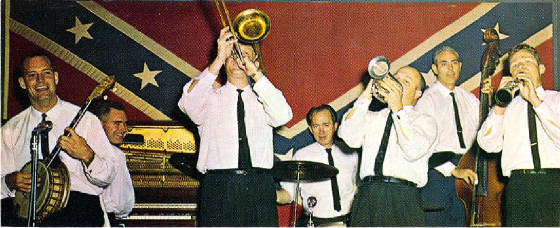
Ed Bernet Dick Bernet TAM Mott Roger
Davidson Tommy Loy Benny Bennett Peyton
Park
|
|
LEVEE SINGERS
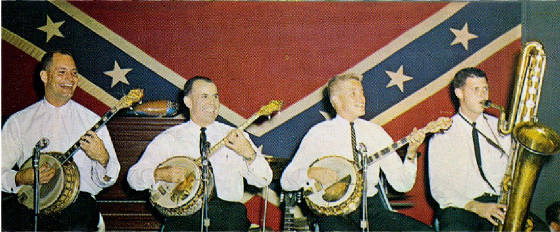
Ed Bernet Smokey Montgomery
Ronnie Dawson Bob Christopher
|
An important part...of Ed Bernet's past was his small nightclub in Dallas, The Levee.It was early 1961, Jack
Ruby, who later gained world-wide and historical notoriety by murdering presidential assassin Lee Harvey Oswald, had hired
Ed's dixieland band for several weekends in Jan and Feb at his downtown Dallas Sovereign Club. He was unwilling to sign
a contract Ed offered him for the group to play a year of weekends at Ruby's downtown Dallas Sovereign Club. He wanted
to make an oral committment but didn't want to sign a contract.
Ed decided he'd go back out to a small club, The Dallas Jazz, Ltd., at 5616 East Mockingbird Lane
in Dallas, where his group had been playing for a number of months prior to the Sovereign Club gig, since Ed had returned
to Dallas from the Air Force and from pro football. He was able to take over the lease on that club. Because he was also in
the construction business, specializing in building new homes, and had built and sold several homes and had done some home
remodeling in the Park Cities area, he had a building crew that was able to remodel and redecorate the club within a few short
weeks. The doors were opened on March 16, 1961. The decor was more funky than fancy ("funky" was probably not a
word at that time)...blue-grey walls and ceiling, long, narrow tables with red tablecloths, black wooden slat chairs. The
small stage on the West long wall was 8'x 12', just big enough for Ed's 7-pc dixieland band to squeeze on stage. Behind it
he hung a large Confederate flag as the backdrop. The name "Levee" was thought to be fitting as a place for dixieland
music.
The Levee Dixieland Seven at that
time was made up of some of those he had played with during his years in SMU, where he was member of the Cell Block Seven,
a very popular dixieland show band that wore black and white striped outfits. The CB7 played SMU fraternity and sorority parties,
clubs, special events of all kinds, opened for Bob Hope when he did a concert in Dallas, played a two-week engagement at the
Riviera Hotel in Las Vegas, finally made it to the Ed Sullivan Show on national TV (but missed getting on at the last minute
because the early part of the show ran too long). Tam Mott (trombone), Tommy Loy (trumpet), Ed's brother, Dick (piano) and
Ed (banjo) from that band were the nucleus of the Levee Dixieland Seven. Joining them were Roger Davidson (drums, who came
up with the idea to name the club "The Levee"), Benny Bennett (bass) and Peyton Park (clarinet). Those seven musicians
quickly began drawing standing-room-only crowds on Friday and Saturday nights.
It was dixieland on Fri and Sat nights...but what could they do on Sun through Thu? The Red Garter,
in San Francisco, was a well-known, successful club that featured a banjo band and audience sing-a-long participation. Ed
borrowed on that idea and formed a small pickup band with a couple of other banjo players and Bob Christopher on the bass
sax. He made song sheets, distributed copies on the tables and started what came to be known as The Levee Banjo Band. The
crowds began increasing gradually during the first few weeks until one of the country's best banjo players, Smokey Montgomery,
was invited to come and play with the band. He liked the idea and became a regular. He had been leader of the Lightcrust Doughboys
Western Swing band for many years and knew a young guitar player/singer that had played with the Doughboys that did a combination
of country and pop music...Ronnie Dawson, from Waxahachie, Texas. As a teenager, Ronnie had been a star at the Big D Jamboree.
Ronnie enjoyed his night playing at the Levee, the people loved him, and he became a regular. Those four...Ed Bernet, Ronnie
Dawson, Smokey Montgomery and Bob Christopher...started as the Levee Banjo Band and later changed their name to The Levee
Singers. The Levee was wildly successful,
almost from the very beginning...the Levee Dixieland Seven on Fri-Sat nights, the Levee Singers on Sun-Thu nights. A
little over one million people filled the place during it's 10-year run, night after night, often standing in line
outside, waiting for the next set to be over in order to fill the seats of those who were leaving. The liquor laws in Texas changed in the
late '60's, enabling restaurants to serve mixed drinks...more and more restaurants were able to have "live" music.
People who had formerly eaten dinner at a restaurant and left when they were finished to come to the Levee were now able to
enjoy many different kinds of music in many of the nice restuarants. That, added to the fact that Ed became involved
in several other businesses...and he wanted to be able to be home at night more often with Susie and their 3 young kids...Blake,
Brant and Jenny...led him to sell the club to several of the men in his dixieland band. They later sold it to Ronnie
Dawson, who had gone out on his own in the late '60's.
The space was ultimately taken over by a jewelry
store...which was appropriate, because, during its' 10 year lifetime, The Levee was a "Jewel" among night clubs.
Its' manager for most of that time, was Tom Kenchel. He was responsible for all the operations of the
club...working days and nights...including the hiring and management of the waiters and the men who "helped at the front".
They were all men of the highest caliber and character, many of whom were teachers and coaches during the daytime...all of
whom went on to great success in their individual "daytime" businesses. Many people have commented, through
the years, that they loved not only the music and entertainment at The Levee, but the fact that they were treated so well
by all those who worked there. Tom was responsible for that.
After The Levee closed, Tom remained as
the manager of Ed's recording studio, Sumet-Bernet Sound Studios, for more than 20 years. Tom's wife, Kay, was the company's
secretary for most of those years.
The Levee was a wonderful part of the lives of the musicians and those
who worked there...and the more than one million visitors who had so much fun there during the 1960's.
|